The Radio 270 Antenna
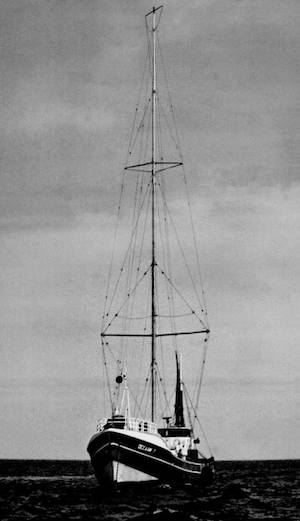
The antenna installer was already aboard as he had sailed up with us from Guernsey to pre-tune the antenna. The mast was constructed from aluminiuml, and the cage of cables forming the radiator was made of phosphor bronze. It had been pre-tensioned for stability and to improve its radiation characteristics.
The length of cable had hoops along the cage's length to spread the wire out and give a constant diameter to the cage. This helped increase the bandwidth of the antenna giving much better audio fidelity than a narrower radiator would give. The cage looked a bit like a long sausage, thus it was often known as a sausage aerial.
FOLDED MONOPOLE
The antenna design was quite clever for the time; it was end fed from the deck tuning house and had a very short feeder which was very low loss coaxial cable, 3 inches in diameter.
The antenna was configured as a folded monopole, with the mast being at earth, grounded to the ship's keel. This avoided having the mast mounted on large porcelain insulators, as was generally the case until the 60s. If a base insulator had been use it would have been under extreme stress with the constant movement of the vessel and the weight of the mast. It was known that other radio ships had problems with their base insulator-fed masts cracking and failing, not what you want out at sea!
"While off Norfolk, we managed to run the first part of the transmitter, the exciter, up on test and then we put out the Beach Boys 'Party' LP for a while," says Stephen Muirfield. I don't now if many listeners heard us but we we're trying very hard to get a signal out. We were working to finish the installation of the equipment in between frequent bouts of sea sickness in very choppy seas.
Technical Details
of Radio 270


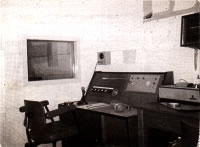
Radio 270 main studio
(above) and the
270 newsroom,
(below).
RCA engineers
The RCA good guys team of RF engineers were led by Tony Untendale. They were not at all happy about having to come out and do the final installation at sea as none of them were sailors. They were brought out to Scarborough by one of Bill Pashby's fishing cobbles, along with all their test equipment, which in those days was very large and bulky.
After their nightmare of a ride in heavy wallowing seas they had to scamble onto the Oceaan 7, not a job for unseasoned sailors. But the day when the mast came crashing down was the end of the line for them. They were scared witless by the experience. Tony sent a memo to their European head office to say that in future they would only carry out work in harbour and that they wouldn't ever go to sea again.
And so the day ended for us, finally safely tied up in harbour. We we're thankfull that no one had been swept overboard! We didn't know what the future would hold for us and most of the directors were quite despondent as they had personally invested a lot of money, time and their reputations on the venture.
The launch party had been totally ruined and some felt that the newspapers were going to be very anti Radio 270. A lot of press advertising had been sold by the papers in the form of "Good Luck" messages; those clients would likely be hopping mad and the local businesses would all cancel their news paper advertising contracts. And it wouldn't be of any help to us in our efforts to sell air time!
An Engineer's Revenge
Chief Engineer Peter Duncan had gained his experience at Scottish Television in Glasgow (now called STV) and using his experience had followed the routines and principles adopted in television for sound. The production and network techniques revolved around a lot of the output being pre-recorded. The original studio that Peter built was designed with those criteria in mind and was perhaps a little bit "over-engineered."
There was huge board room battle and Peter Duncan was removed from his post as Technical Director and replaced, with the land based studio in Newcastle being closed down. A few days later, Peter crept on board the Oceaan 7 in Grimsby docks while the crew, including the night watchman, were across in the pub and stripped out all his studio equipment from ship.
The crew and the watchman had quite a bit of explaining to do the next day, but they were all sacked. Paul Burnett & Hal York were given more work standing in for them to stop any further visitors coming on board and security was very tight. Even Wilf's young son Ian was pressed into the security team.
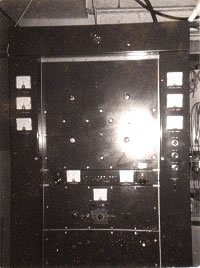
Radio 270's Limiter and its replacement
There were considerable problems with replacing the orginal limiter which had been damaged in the storm on April Fools' Day.
This is a a vital part of equipment that kept levels in the audio chain constant. This was made by PYE in Cambridge, but that company was in turmoil and in the process of being bought out by Philips, a Dutch firm.
Getting Pye's factory in Cambridge to build the replacement limiter took quite a long time as the kit was all custom made and not something you could just order "off the shelf". There was very little demand for them as there were not so many radio stations in those days, in fact the design was a converted TV one used to keep TV volumes constant.
This created a major problem for our transmitter which we were unable to run at full power or with full programme modulation. To do so without a limiter in the circuit could have damaged it and caused interference to other stations. For several weeks we had to keep everything turned down and manually control volume levels and keep a very close eye on some of the more over-zealous DJs, whose exhuberance could have blown us off the air at the drop of a hat. Quite exciting times with some very inexperienced and green-horn DJ's on board; engineering on Radio 270 was quite a challenge.
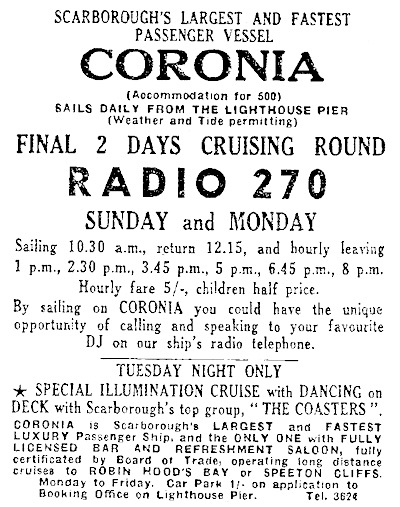
Radio 270's programmes were all originated on board the radio ship, the Ocean7, with just a few exceptions:
The World Tomorrow was a daily religious and political programme hosted by Garner Ted Armstrong. it arrived on 7 inch spools of open reel tape and was played in from the onboard studio. The same method was used for some political programmes broadcast on the station by the York University Students Union.
One further programme arrived on open reel tape, the Sunday Times Hour of Jazz, broadcast once a week for some months in 1966.
The onboard studio was in two parts. Mid-ships was a newsroom, built by Radio 270's first Director of Engineering, Peter Duncan. Alongside the newsroom, to the port side of the ship, was a self contained self-operating studio for DJs. They sat facing the control panel, which was curved vertically to fit the hull of the ship and was the only vertical mixing studio on any radio ship. In the centre of the panel at DJ eye height was mounted a BULOVA Accutron clock, a great time piece!
RCA Transmitter
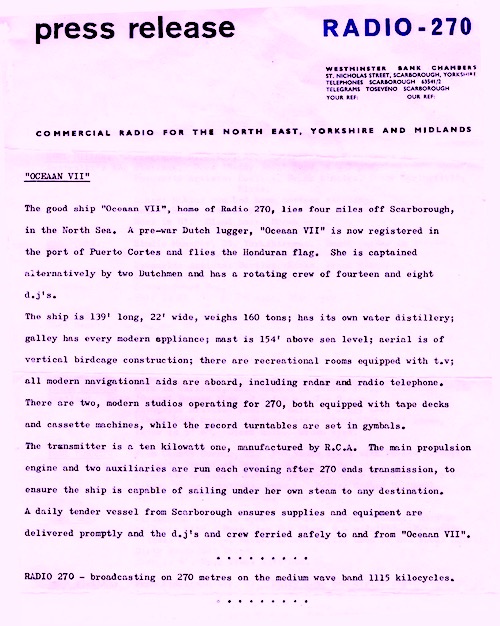
Radio 270 only ever had one transmitter, a new RCA BT10J unit. This was assembled in Guernsey in the Channel Islands and was identical to other RCA units supplied to Radio 390 (on the Red Sands Fort in the Thames Estuary) and Radio Scotland.
Radio 270 gets new
Studio Equipment
After the damage casued on 1st April with the false start, that wasn't!) a lot of the studio equipment now needed to be replaced, this time with something more suitable for live presentation of programmes.
Steven Muirfield had an exciting time developing the new equipment at Tunstall Byers near Doncaster. Their engineers were on the ball and had excellent ideas for equipment design for the Oceaan 7's very cramped studio, having previously designed and built disco playout equipment for several night clubs in Yorklshire.
The new Radio 270 studio had almost all the broadcast audio equipment constructed in a vertical rack, which was designed to fit the curvature of the vessel behind it, being jam tight against the side of the ship's port side.
This meant that much of it was able to be pre-wired and tested at the TB factory and it just needed to be dropped in place on board the ship. This saved a great deal of time. As well as the TB team's experience installing equipment in night clubs and discotheques, they also had a hi-fi shop and so could appreciate good sound quality.
Tunstall Byers also had a very friendly work force and a brand spanking new metalwork shop; it was fully equipped with some very useful tools and had installed a huge metal press. This had the ability to stamp out boxes and cabinets for some advanced new medical call units.
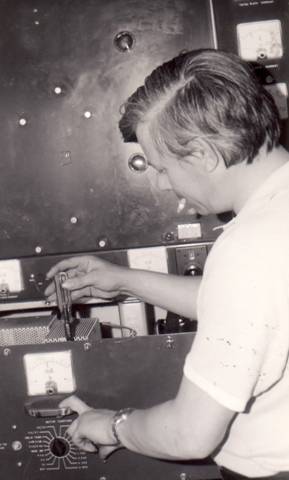
Chief Radio Engineer Keith Robinson RIP
who joined Radio 270 from Radio Essex,
making adjustments to the 10kW transmitter
Microphone
The main microphone, an AKG D-12 was originally mounted on a desk stand, however this was a bity impractical for the DJs when trying to juggle records, tapes, and a bucket to be sick into! Engineer Stephen Muirield had a solution: he made a long arm bracket which was mounted at the top of the panel, which gave more space on the desk for the DJ.
Radio 270's transmitter
an RCA BT10J, new in 1966
Some more
technical info'
about Radio 270
The final programme on Radio 270 on August 14th 1967 saw Programme Director RUSTY ALLEN bring in most of the ship's crew to be interviewed on the air, and naturally Rusty let them talk listeners through some of the equipment.
During that final hour, PD Rusty Allen and the engineers gave the most comprehensive run down of the station's equipment. Unlike later stations, Radio 270 never featured a 'guided tour of the radio ship on the air', mainly because remote or wandering microphones were not a realistic possibility in the 1960s.
So if it's a description of the equipment that you would like to hear, courtesy of the guys who made it all work, then the Final Hour of Radio 270 is, without doubt, one of the most informative programmes ever heard.
Enthusiasts should get a copy of the programme NOW and listen carefully - it's a lovely emotive journey too as Rusty spins some significant tracks and many of the adverts for which Radio 270 is still fondly remembered. Its just £7.25 for a copy of a CD containing the programme, so you can play it whenever you wish.
A long-lasting souvenir
of Radio 270.
Her Final Hour
AUGUST 14TH - 1967
Radio 270 closedown
Featuring Head of Programmes,
Vince 'Rusty' Allen
This is the final 60 minutes of the life of Radio 270. The programme includes many Radio 270 DJ's, including Ross Randell, Paul Burnett and Guy Hamilton.
Rusty also chats to the members of the crew of the Oceaan 7, and plays recordings of other DJ's who were unable to get out to the radio ship for the last night on the air due to the weather. Hear again messages from Leonard Dale, Chairman and Wilf Proudfoot, MD of Radio 270.
Over an hour of nostalgia make up this historical recording, right up to Radio 270 leaving the air with National Anthem at one minute to midnight. (This is a good quality off air recording, not the rubbish heard on YouTube!.)
Only £7.99 incl P&P in the UK
(£10 to send outside UK)
CLICK Button
to BUY
pay only £8.50
for UK Delivery
Non- UK address ?
CLICK button
to pay £12.75
for ex-UK delive, Tax, etc
Radio 270 gets new
Studio Equipment
After the damage casued on 1st April with the false start, that wasn't!) a lot of the studio equipment now needed to be replaced, this time with something more suitable for live presentation of programmes.
Steve n Murifield had an exciting time developing the new equipment at Tunstall Byers near Doncaster. Their engineers were on the ball and had excellent ideas for equipment design for the Oceaan 7's very cramped studio, having previously designed and built disco playout equipment for several night clubs in Yorklshire.
The new Radio 270 studio had almost all the broadcast audio equipment constructed in a vertical rack, which was designed to fit the curvature of the vessel, behind it, being jam tight against the side of the ship's port side.
This meant that much of it was able to be pre-wired and tested at the TB factory and it just needed to be dropped in place on board the ship. This saved a great deal of time. As well as their experience installing equipment in night clubs and discotheques, they also had a hi-fi shop and so appreciated good audio quality.
Tunstall Byers also had a good work force and a new metalwork shop, fully equipped with some very useful tools and a huge metal press. This could stamp out boxes and cabinets, used for medical call units.
The Radio 270 Antenna
The antenna installer was already aboard as he had sailed up with us from Guernsey to pre-tune the antenna. The mast was constructed from aluminiuml, and the cage of cables forming the radiator was made of phosphor bronze. It had been pre-tensioned for stability and to improve its radiation characteristics.
The length of cable had hoops along the cage's length to spread the wire out and give a constant diameter to the cage. This helped increase the bandwidth of the antenna giving much better audio fidelity than a narrower radiator would give. The cage looked a bit like a long sausage, thus it was often known as a sausage aerial.
FOLDED MONOPOLE
The antenna design was quite clever for the time; it was end fed from the deck tuning house and had a very short feeder which was very low loss coaxial cable, 3 inches in diameter.
The antenna was configured as a folded monopole, with the mast being at earth, grounded to the ship's keel. This avoided having the mast mounted on large porcelain insulators, as was generally the case until the 60s. If a base insulator had been use it would have been under extreme stress with the constant movement of the vessel and the weight of the mast. It was known that other radio ships had problems with their base insulator-fed masts cracking and failing, not what you want out at sea!
There were considerable problems with replacing the orginal limiter which had been damaged in the storm on April Fools' Day.
This is a a vital part of equipment that kept levels in our audio chain constant. This was made by PYE in Cambridge, but that company was in turmoil and in the process of being bought out by Philips, a Dutch firm.
COMING SOON
full description of Radio 270's unique vertical mixing panel
The doors open by themselves!
The close relationship with Tunstall Byers began when Wilf met one of Tunstall directors at Wilf's garage when he was installing some electronic robot car salesmen. This equipment was activated when you opened the car door: it started a tape-loop that told all about the car's good features.
Wilf was very taken with this superb idea. "That is champion," he had said and began looking at ideas to automate his own supermarkets. He certainly had the first automatic doors in Yorkshire and it became a well known slogan in his advertising "Proudfoots, where the doors open by themselves!"
The company who rebuilt the studio, Tunstall Byers, were also agents for Revox tape recorders, which were at the cutting edge of technology having developed multi speed recording.
Revox had also developed multitracking and were at the forefront of such techniques. This kit became very useful for commercial production work, also though Radio 270 offered 'live reads' of commercials too. The Revox equipment had remote start and stop capabilities, quite unique for the time. They could also trigger another tape recorder using stop foils spliced into the tape.
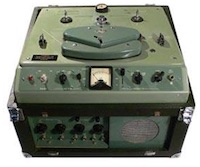
The EMI tape recorder in the
Radio 270 studio: an EMI TR52.
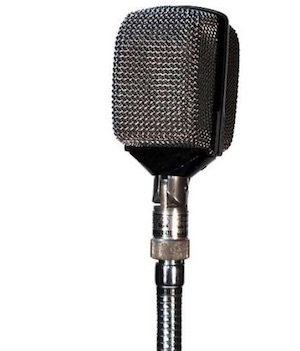
The Radio 270 microphone, a true workhorse, the AKG-D12
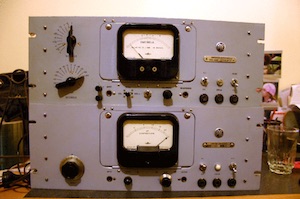

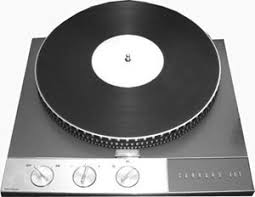
Turntables
The the right of the DJ were two Garrard 401 turntables, mounted in gimbals. These were a mechanical device that kepty the turntables roughly horizontal, by using gravity. The DJ and everything else on the ship may have been rocking, but the platters stayed roughly horizontal.
Tape Recorders
Radio 270 did invest quite heavilly in good quality audio kit, unlike some of the other stations that tried to adapt domestic equipment. The dstation had two open-reel machines on board used for commercials, jingles and the pre-recordfed programmes. Quite heavilly used then, so it was important they were good solid makes and kept "in-spec"
Toi the left of the DJ, was mounted a REVOX, and to the right an EMI TR52.

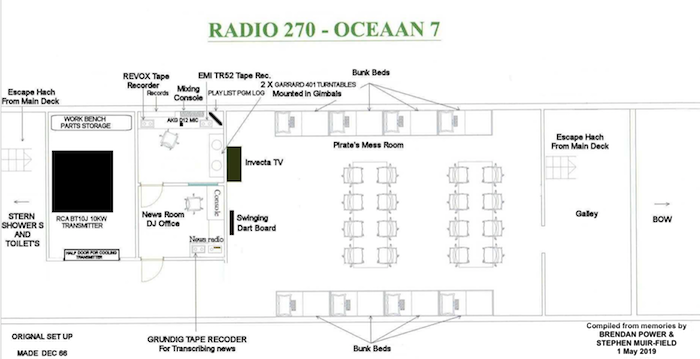
Oceaan 7
GENERAL ARRANGEMENT PLAN
(double click to download)
Radio 270's programmes were all originated on board the radio ship, the Ocean7, with just a few exceptions:
The World Tomorrow was a daily religious and political programme hosted by Garner Ted Armstrong. it arrived on 7 inch spools of open reel tape and was played in from the onboard studio. The same method was used for some political programmes broadcast on the station by the York University Students Union.
One further programme arrived on open reel tape, the Sunday Times Hour of Jazz, broadcast once a week for some months in 1966.
The onboard studio was in two parts. Mid-ships was a newsroom, built by Radio 270's first Director of Engineering, Peter Duncan. Alongside the newsroom, to the port side of the ship, was a self contained self-operating studio for DJs. They sat facing the control panel, which was curved vertically to fit the hull of the ship and was the only vertical mixing studio on any radio ship. In the centre of the panel at DJ eye height was mounted a BULOVA Accutron clock, a great time piece!